


Understanding the Apostille Process: A Comprehensive Guide
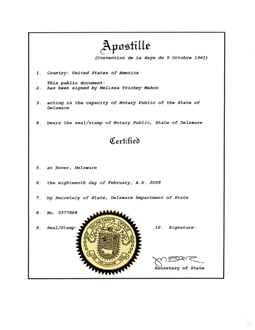
An apostille is a specialized certificate issued by a designated authority that authenticates the origin of a public document. It certifies the authenticity of the signature, the capacity in which the person signing the document acted, and, where appropriate, the identity of the seal or stamp which the document bears.
Governed by the 1961 Hague Convention, the apostille eliminates the need for double-certification, streamlining the legalization of documents for international use among member nations.
When is an Apostille Required?
An apostille is necessary when you must present a public document executed in one country to a authorities in another country, provided both nations are parties to the Hague Apostille Convention.
Common documents requiring authentication include:
- Corporate Documents: Articles of incorporation, business bylaws, commercial invoices, and patent applications.
- Vital Statistics: Birth certificates, marriage certificates, death certificates, and divorce decrees.
- Educational Credentials: Diplomas, academic transcripts, and school verification letters.
- Legal Documents: Powers of attorney, court orders, and notarized affidavits.
The Step-by-Step Apostille Process
Navigating the apostille process requires strict adherence to jurisdictional guidelines. Missing a single prerequisite can result in delays or rejection.
Step 1: Document Preparation and Notarization
Before a document can receive an apostille, it must be an official public record or be properly notarized.
- State/Government Issued: Vital records must be certified copies issued by the proper government registrar (e.g., the Department of Health or Vital Statistics). Photocopies are generally not acceptable.
- Private/Corporate Documents: Documents like contracts or powers of attorney must be signed and witnessed before a licensed Notary Public. The notary must attach the proper legal acknowledgment or jurat phrasing.
Step 2: Verification by Local Authorities (If Applicable)
Some jurisdictions require an intermediate step called "county certification" or "notary authentication." In these regions, the clerk of the county court must verify that the notary public who signed the document holds a valid commission before the document can proceed to the state level.
Step 3: Submission to the Competent Authority
The document is submitted to the designated government body authorized to issue apostilles.
- State-Level Documents: In the United States, this is typically the Secretary of State's office in the state where the document was executed.
- Federal Documents: Documents issued by federal agencies (such as FBI background checks or federal court documents) must be sent to the national competent authority, such as the U.S. Department of State's Office of Authentications.
Step 4: Review and Issuance
The competent authority verifies the notary’s or public official's signature and seal against their database. Once confirmed valid, they permanently attach the physical apostille certificate to the document using eyelets, staples, or specialized ribbons.
Critical Distinctions: Apostille vs. Authentication
It is crucial to understand whether your destination country requires an apostille or a traditional legalization process.
| Feature | Apostille Process | Traditional Authentication & Legalization |
|---|---|---|
| Applicability | Used strictly between countries that belong to the Hague Apostille Convention. | Required when the destination country is not a member of the Hague Convention. |
| Complexity | Single-step validation by the originating country's competent authority. | Multi-step process involving state verification, federal authentication, and embassy review. |
| Final Step | Document is ready for use immediately after the apostille certificate is attached. | Document must be sent to the destination country's embassy or consulate for final legalization. |
Frequently Asked Questions
-
How long does it take to get an apostille?
Processing times vary widely depending on the jurisdiction and method of submission. Walk-in services may be completed same-day, while mail-in requests can take anywhere from a few business days to several weeks. -
Does an apostille expire?
An apostille certificate itself does not have an expiration date. However, the destination country or requesting institution may require that the underlying document (such as a background check or birth certificate) be issued within a specific recent timeframe, usually 3 to 12 months. - Can an apostille be issued electronically?
Yes. An increasing number of jurisdictions now issue Electronic Apostilles (e-Apostilles) and maintain online e-Registers for verification, though acceptance depends on the receiving country's domestic regulations.